Who Has the Baby of the Coma Girl
Second of ii parts. Read part one →
This story was republished on Jan. 4, 2022 to brand it gratis for all readers
Tardily at dark, after the children had gone to bed, Derek Townsend would sit in a bluish velvet wingback chair in his living room and write letters to his wife, who remained gravely sick with COVID-nineteen.
Kelsey Townsend, 32, had come up so close to death that doctors were forced to identify her in a coma earlier delivering the couple'southward fourth kid, Lucy, past emergency C-department on Nov. 4.
Kelsey'southward oxygen level remained low, the vital piece of work of her lungs now dependent on two machines — a ventilator and a heart-lung machine called ECMO.
A calendar week had passed since her delivery. She had yet to hold or even meet her baby.
Unable to visit, Derek wrote his letters from their home in Poynette, describing what the children had washed that 24-hour interval and urging her to proceed fighting. The family unit needed her.
Derek never mailed the letters.
Each day, though, he texted her phone at University Hospital. The texts said how much he missed her. Sometimes he tried to brand her smile.
"You don't past chance know where your wallet is do you?" he joked on November. sixteen.
He found it difficult to maintain the cheerful tone.
"It was a rough day for you today, but you lot have made some skillful steps tonight," the text connected. "It breaks my heart to pieces hearing what yous are going through every 24-hour interval."
He sent each text hoping his phone would ping with a reply, but it never did.
On the night of Nov. 16, Kelsey's left lung collapsed, a life-threatening complexity in which the lung ruptures and air leaks into the breast. The ICU team positioned a tube to drain the air in Kelsey'due south chest until the lung could heal.
Discussion of her struggle spread on social media, so over the airwaves. A radio listener posted a notation nigh the Townsends on the Facebook page for the Q106 morning show.
Madison-based WWQM-FM, known as Q106, plays country music to an audition that stretches from Janesville 80 miles north to Baraboo. Many of the listeners are dairy farmers. Staff at the station pride themselves on their local focus and refer to the audience as their "Q-Munity."
After learning of the Townsends' plight, forenoon host Steph Peters decided to tell the family's story on air.
"And so nosotros know that COVID hits everybody differently, every family differently...only there is a family in Poynette that really needs our assist right now," Peters told listeners on Nov. 17. "Permit'south rally around this family."
Speaking by phone, Kelsey'south cousin, Janel, described the situation: Kelsey remained in critical status in an induced coma. She had nonetheless to hold her new baby, Lucy.
Derek so introduced listeners to two of the children.
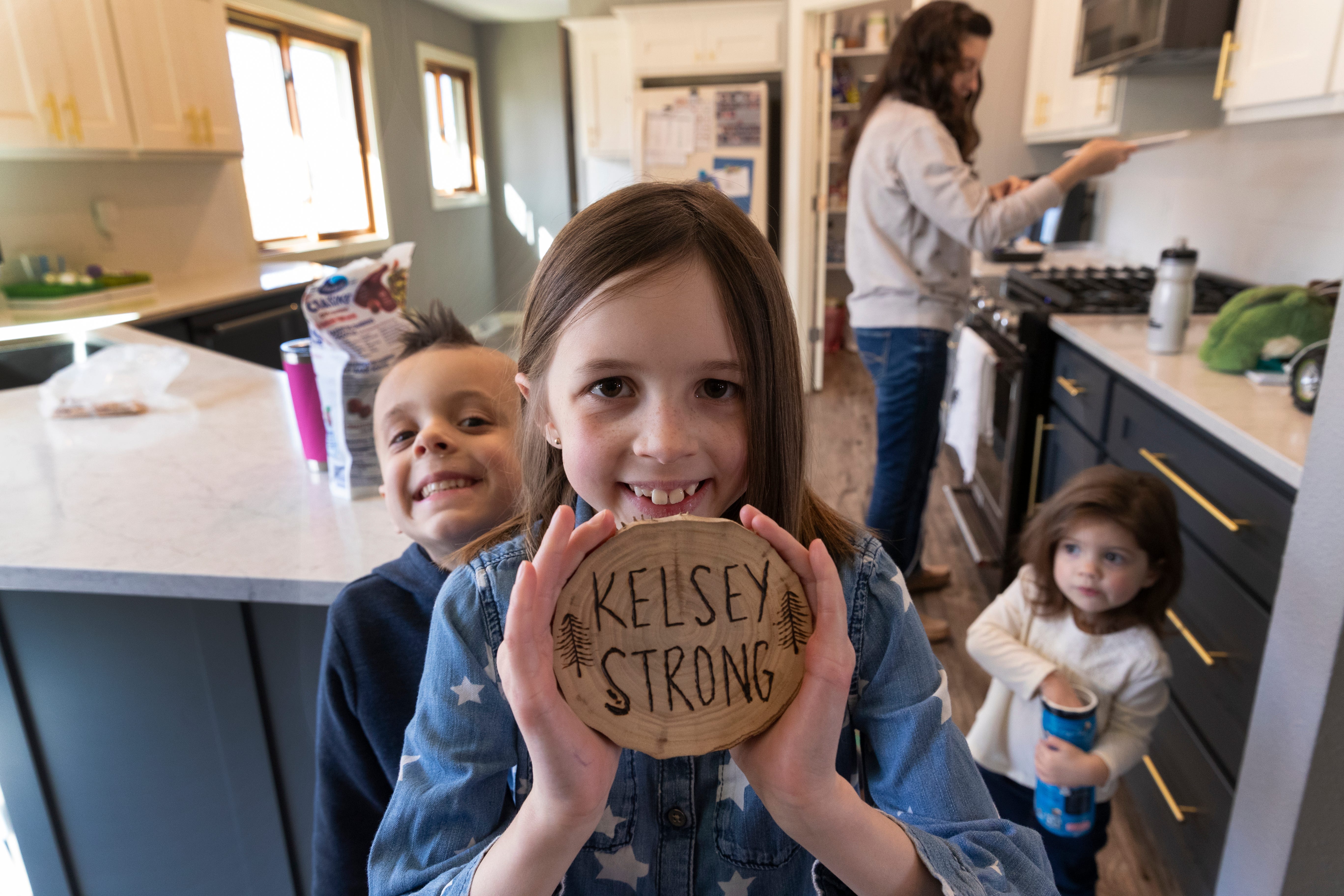
"I miss Mommy's touch," said Payton, at 8 the oldest.
"I miss my Momma's stories," said Beau, five.
Derek thanked the friends and neighbors who had already brought meals to the family and coloring books to go on the children occupied.
"Our family," he said, "is just kind of at a loss for words on how thankful and grateful nosotros all are."
As November turned to Dec, more assistance poured in.
The Culver'southward in Cross Plains sold ane,500 orders of cheese curds to raise money for the family; the line went out the restaurant's door and down the street.
KD'southward Bar & Grill in Lodi held a "Meet Santa" benefit.
In January, a listener texted the morning testify to say, "I'm donating my stimulus check to the Townsend family."
The family's GoFundMe folio would wind upwards raising more than $110,000.
From time to time, the Q106 morning bear witness returned to the Townsends, calling family members for updates. Even when the news was bad, Kelsey'southward relatives focused on their hope and faith.
"They kept us uplifted," said Peters, the morning show host. "I never went to a dark place when I was thinking about Kelsey."
Rails COVID and the vaccine in Wisconsin:Come across the latest data on cases, deaths and administered doses
Wisconsin vaccine FAQ:Who's eligible, where to get it and what's adjacent
Kelsey'southward right lung complanate, and her left lung collapsed a second time.
Derek phoned her room and spoke to her, fifty-fifty as she drifted forth in a coma unable to talk. Sometimes he heard voices in the background that sounded panicky, and it was hard not to feel the same.
Doctors said Kelsey was suffering from Acute Respiratory Distress Syndrome, a severe complication of COVID-19. Even with handling, 25% to 40% of the COVID-19 patients who become the syndrome practise not survive.
At times, Derek allowed himself a grim thought: "This is information technology."
"A lot of that information I kept to myself," he said later, "because at one in the morning there's no need for anyone else to exist awake staring at the ceiling fan."
Mixed in with the bad days were better ones, even flashes of promise.
In early December, one of the nurses showed Kelsey photographs of the children and read aloud letters Payton had written. Kelsey nodded her caput, and her cousin reported the moment on CaringBridge, adding, "I asked God for a miracle, and I feel this is a pocket-size one ..."
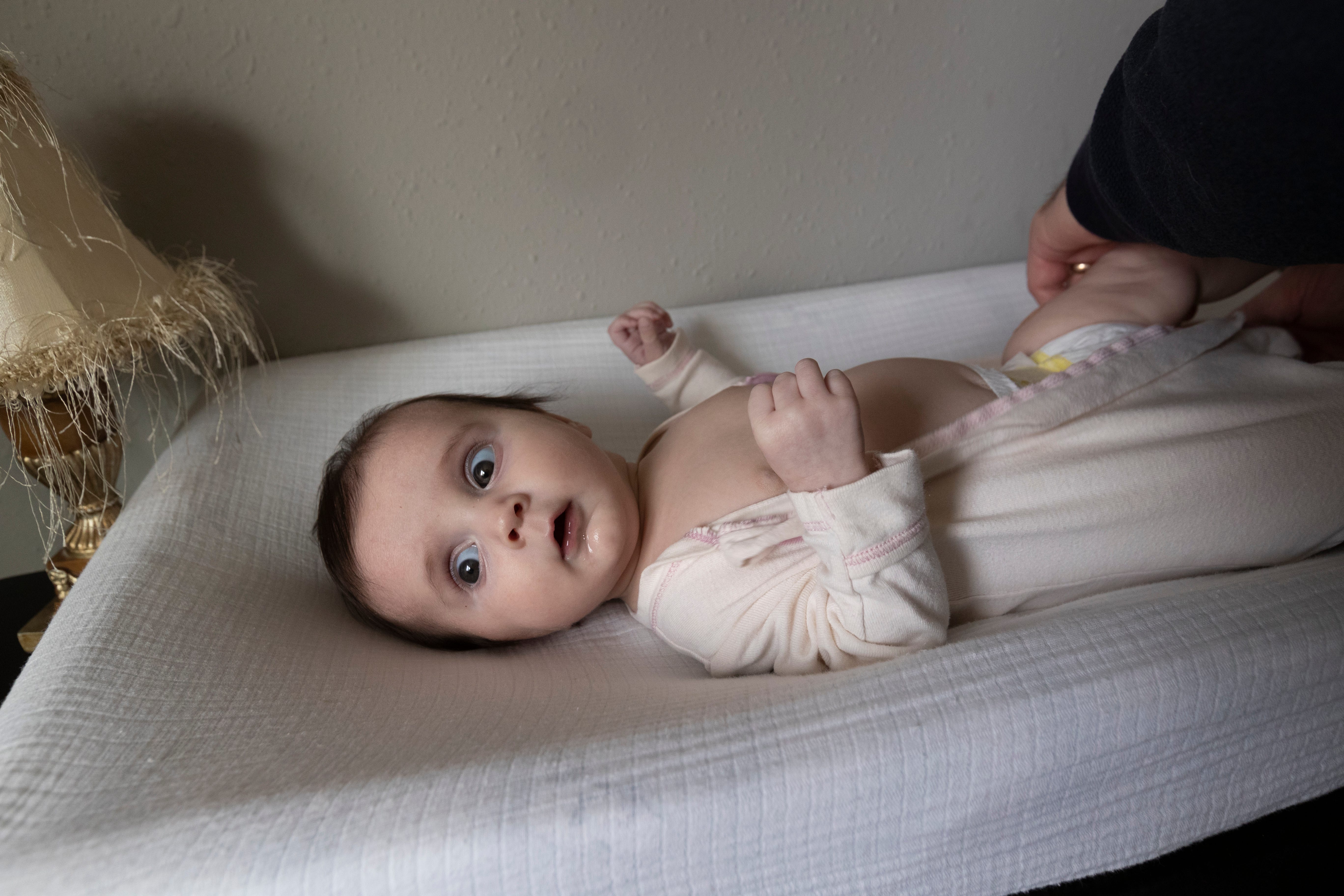
That same day, Derek took Lucy for her one-calendar month checkup. The infant was in the bottom 10% for weight, but otherwise fine.
In mid-Dec, Faith, the couple's xviii-calendar month-sometime girl, and baby Lucy got to FaceTime with Kelsey, who notwithstanding could not have family in her room. Janel described the moment on CaringBridge:
Kelsey smiled equally a tear rolled down her cheek, as this was the very first time Kelsey has seen her newborn, Lucy, who is now six weeks onetime😘 (this gave me chills when I received this update!).
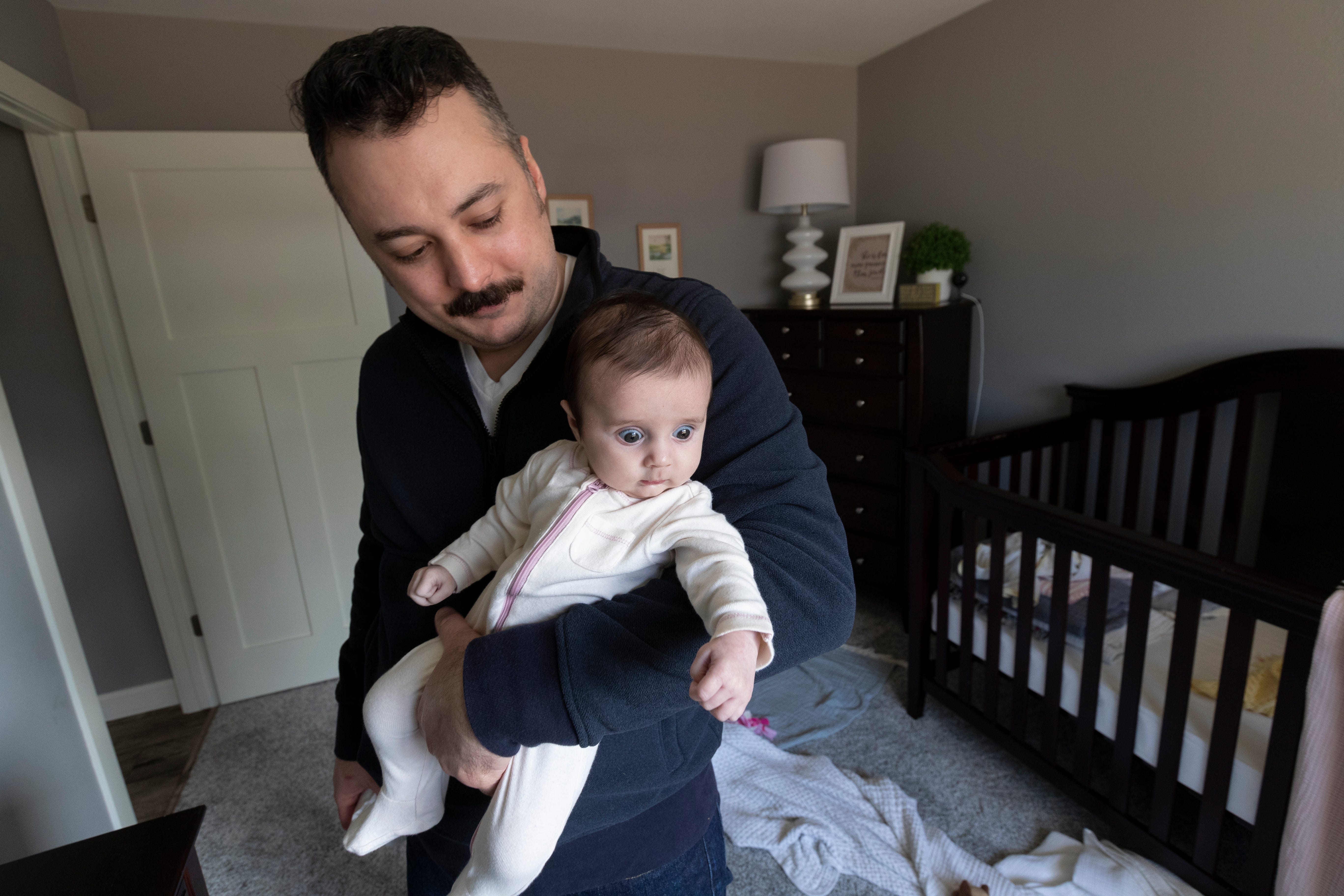
On Christmas Eve, before driving to the hospital to tell Kelsey that she needed a double lung transplant, Derek texted her:
"It's been over seven weeks since I got to agree yous in my artillery. ... This is non the way I wanted it to get but we have a path for you lot to come home now. I'k actually struggling with it. But if this is our option, we volition adjust."
Kelsey had now been on the artificial lung for 46 days. She could not remain on the automobile indefinitely.
Dan McCarthy, Kelsey's main doc and director of the ECMO programme for UW Health, was disappointed that her lungs had improved then niggling. He worried too that the longer she stayed on the ventilator and on the ECMO machine, the greater the chance of her developing a severe complication.
"Afterwards approximately 6 weeks of support, if nosotros don't encounter signs of significant recovery, we take to take a backup plan," McCarthy said.
That plan was the double lung transplant, a risky operation that would crave finding donor lungs just the right size. Kelsey also would accept to exist healthy enough to survive an operation that takes viii to 12 hours.
Preparing to tell Kelsey that this was her path dwelling house brought back hard memories for Derek. At 15, he had stood at his female parent'southward bedside every bit she died of breast cancer.
Hard every bit that had been, the talk with Kelsey on Christmas Eve was harder still, the most difficult thing he'd e'er done. There were times when his emotions overflowed and the medical staff turned away to give the couple privacy.
The next morning, Christmas Day, Derek kept his emotions in check every bit all-time he could. He felt information technology was important "to article of clothing a stiff cape for the children."
So the family celebrated. It was not i of their traditional Christmas gatherings, which bring together up to 60 relatives and friends.
Still, the children opened presents. Derek videotaped them and so that his married woman could watch when she came home.
In December and early on Jan, as Kelsey fought for her life, nonetheless in a coma, iii eerily similar cases of pregnant women with COVID-19 were reported.
Erika Becerra, a 33-year-one-time Detroit adult female with COVID-19, gave nativity to a healthy male child in mid-November. She so declined quickly, dying 18 days after she was placed on a ventilator.
Vanessa Cardenas Gonzalez, a 33-year-old Los Angeles woman, gave birth to a babe girl just days after testing positive for the virus; Gonzalez was placed on a ventilator and died on December. 14.
Ashley Gomez, a 30-yr-old nurse from Northridge, Calif., was sick with COVID-19 symptoms when she delivered a baby boy on Dec. 18. She had to be placed on a ventilator the following twenty-four hour period and died on Jan.3.
In Poynette, Kelsey's family held out hope that she would somehow come up out of the blackout and survive.
COVID-19 forced mother to requite birth in coma, and so threatened her life. How she and her husband made it.
Kelsey Townsend was in a coma with COVID-19 when she gave nascence to her fourth child, Lucy, Nov. iv. She wasn't able to hold her infant till Jan. 27.
Bill Schulz and Marker Hoffman, Milwaukee Journal Sentinel
Derek continued texting Kelsey every day.
The texts were Hail Marys, not so different from the letters stranded sailors once blimp inside bottles and tossed into the ocean.
Kelsey was and then ill. Could she hear her cellphone? Did she always wait at it?
It didn't matter. Derek checked his telephone each day in the slim hope of finding a response from her.
The doctors in Madison prepared the paperwork for the lung transplant. Although she was still quite ill, Kelsey began to receive physical therapy. She had been in bed for more than eight weeks, then long she'd lost the muscle force to stand up or sit up, permit alone walk or take a shower.
The weeks had been hard on her medical team, also. McCarthy felt nervous much of the time Kelsey was in the hospital. Her condition had to exist managed and monitored constantly. Often, he worried that despite their efforts, she might not survive the illness.
The doctor made himself bachelor at all times. In one case, after working a 30-hour shift, McCarthy received word that Derek was trying to attain him. Information technology was belatedly at dark, but the physician phoned Derek, then spent an hour patiently answering his questions.
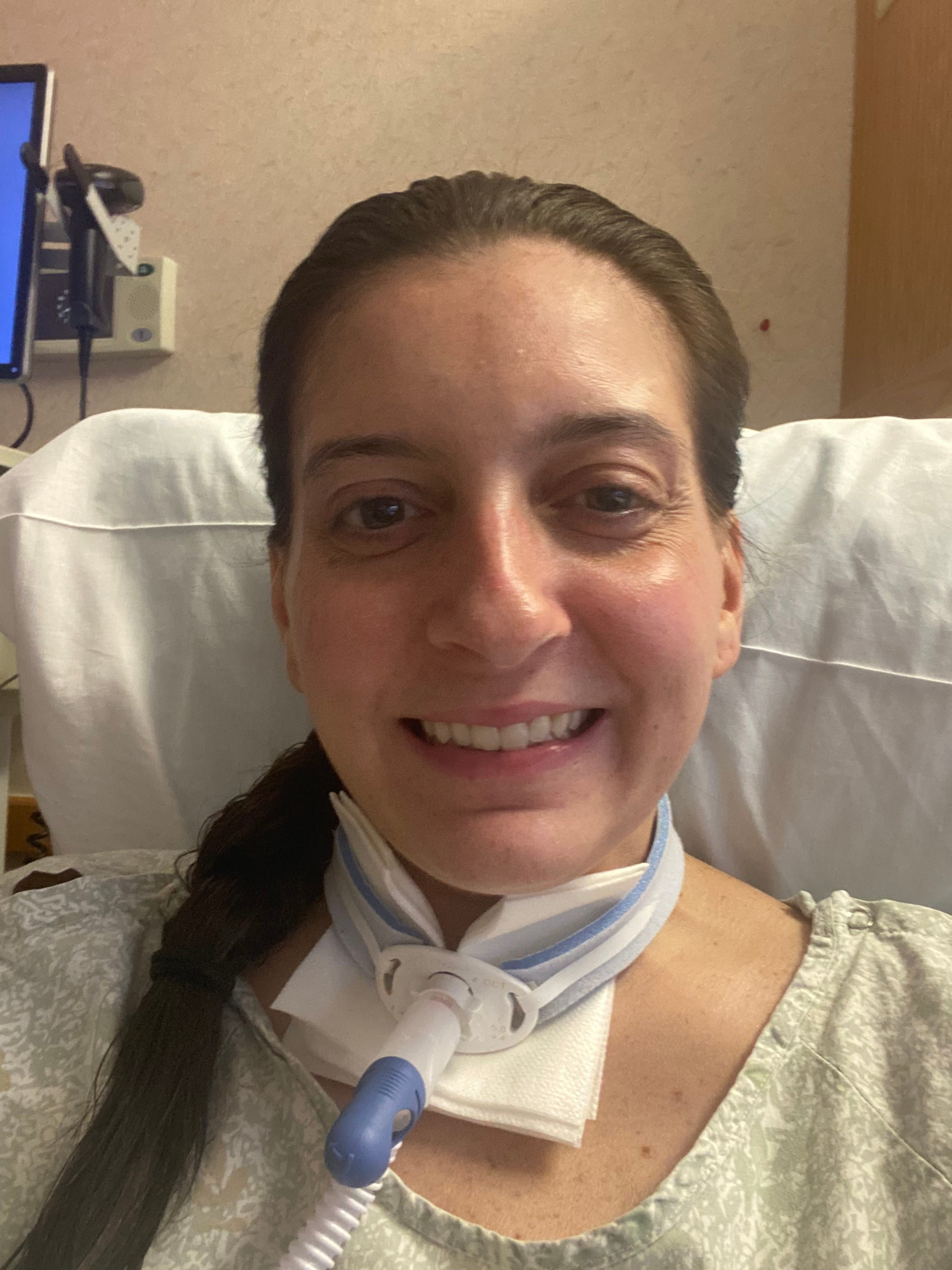
In early January, Kelsey's cousin wrote on CaringBridge:
Kelsey's medical squad continues to wean her off a lot of her medications which she is tolerating well.
Concrete therapy is a piece of work in progress — yesterday, she was able to sit upward at the border of her bed and dangle her feet, and today, with a lot of help, they had Kelsey out of bed and standing!
It was effectually this fourth dimension that Kelsey remembers waking from her coma. She remembers thinking of her married man and the children. She remembers praying.
Then her eyes fixed on the window in her room, on a flash of brilliant reddish. As she stared, she realized what information technology was. A cardinal had perched exterior on the window ledge.
In Christianity, the cardinal is considered a symbol of promise. The bird besides reminded Kelsey of her grandmother, Sally, who had been blessed with the most bright red pilus.
"It was a sign to me," Kelsey would recall much later on. "I accept so much to alive for. I have to fight."
On the morning of Jan. v, Derek woke in Poynette and checked his phone, as he always did. This time the screen wasn't bare.
At 3:39 a.g., Kelsey had texted:
"What I wouldn't requite to exist next to y'all.
What is Lucy's DOB? I don't remember having her."
Derek had grown accepted to the one-way conversation on his telephone. Now, he stared at his wife's first words to him in 2 months.
He typed back:
"Oh my goodness infant I've sent you over 100 text messages.
"To see y'all answer brought me to tears this forenoon. I'm distressing!"
The day after texting her husband, Kelsey was placed on the national lung transplant list. Her case was considered so urgent that she was near the summit of the list.
The hospital in Madison began receiving offers of lungs. The organs were not ideally suited to Kelsey, so doctors held out, hoping for a amend match.
There was discussion within the medical team. Should Kelsey be given time off the machines to notice out what her lungs could do on their own?
The elation Derek felt seeing Kelsey'due south text did not drive abroad his doubts. He never felt sure she would come up home.
And then, on Jan. x, a Sun, he answered a call from McCarthy.
"Derek," the doctor said. "Something miraculous has happened."
The images of Kelsey's lungs had begun to look much meliorate. McCarthy could see more air filling the lungs. Air at present fabricated information technology through areas damaged past scars and inflammation. It was possible, McCarthy said, that Kelsey might non crave a transplant, that she might take a different path home.
The following day the phone rang once more. Derek picked it upwards and heard the doc say: "I don't know why this is happening, but her lungs are significantly better than yesterday. They wait like a prepare of lungs. In that location'due south a good gamble that she comes dwelling house with her ain lungs."
Kelsey's cousin wrote a new entry on CaringBridge:
Divine intervention! A phenomenon or an act of God! Her lungs have regenerated and the scar tissue is subsided.
In retrospect, McCarthy believes Kelsey's lungs must accept been improving steadily in January, a trend that began subtly. Only he cannot fully explicate the change. The irreversible had reversed.
"I'll accept to reconsider," McCarthy said after. "If we have a similar patient, at what point do we say recovery is no longer possible?"
Kelsey'southward doctors stopped considering offers for her lung transplant.
Normally patients equally sick every bit she had been transition from the infirmary and then spend many weeks in rehabilitation.
Kelsey began physical therapy sessions in the hospital and never required transfer to a rehabilitation facility.
Early on, she was so weak she could merely jerk her toes and fingers. She could not lift her hand to wave. But knowing that she might exist able to come home with her own lungs inspired Kelsey, and she began to push herself.
Eventually, she would work through hr of in-person physical therapy, then ask for xxx minutes more. She grew weary of her dependence on the machines to aid her exhale.
The medical squad asked, "Are you more nervous well-nigh having ECMO taken off, or almost having information technology stay in?"
"If it'due south safe," she said, "I want to be off information technology."
On January. thirteen, after nearly 65 days on the bogus lung — the longest of whatever COVID-19 patient at University Hospital — Kelsey was disconnected from the car.
She was notwithstanding supported past the ventilator, just the amount of support diminished. She kept pushing harder in physical therapy.
One day she told Derek that she wished she could be moved to the intermediate care section, or even the hallway, then that her ICU bed could be freed up for another patient.
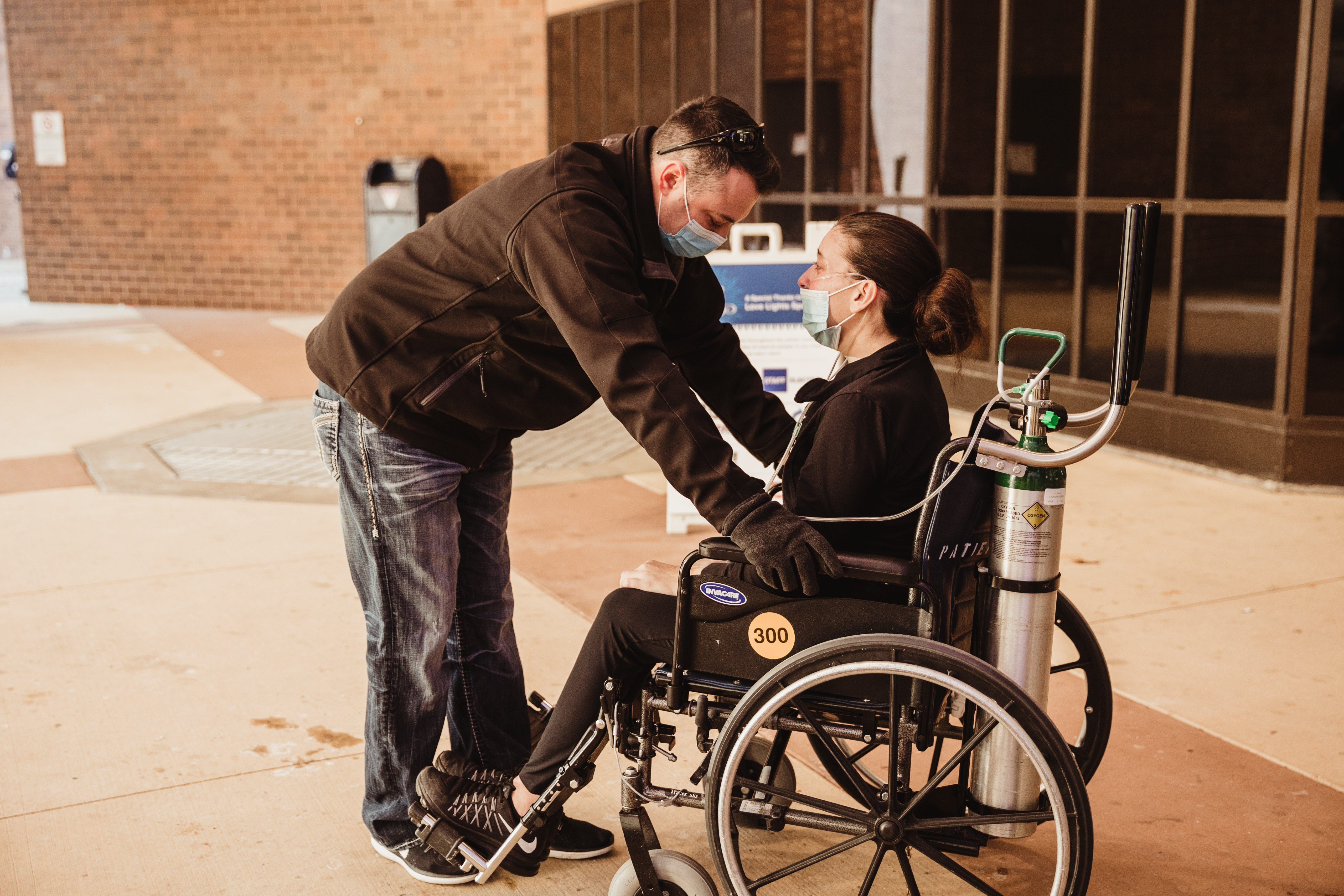
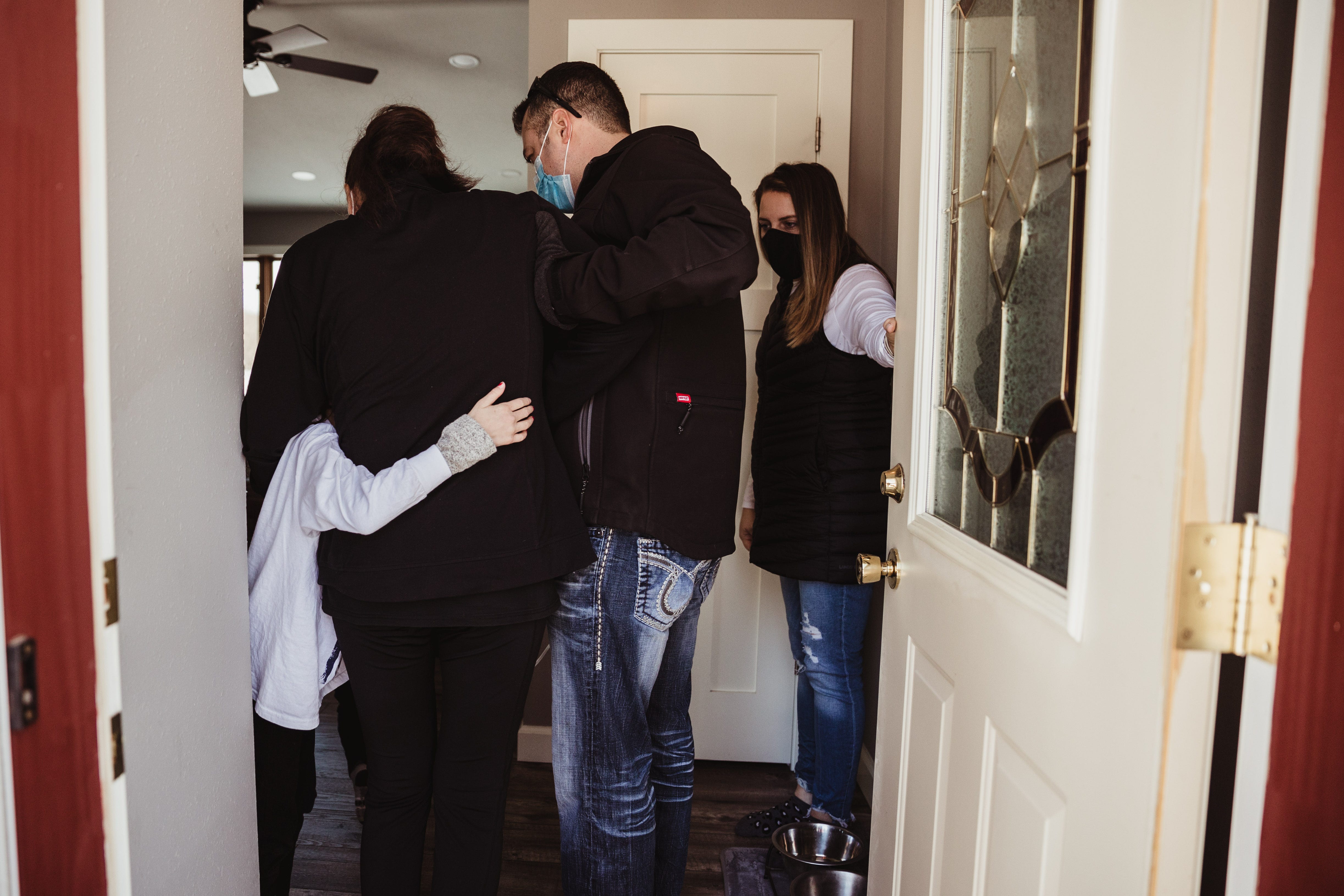
The morning time of Jan. 27, Kelsey rushed through everything: breakfast, brushing her teeth, showering.
She was going dwelling house to Poynette.
Derek would exist picking her up. As he drove to the infirmary, he felt more nervous than he had on his wedding day. The children stayed at domicile with their grandparents.
The four-bedroom white ranch looked to Kelsey unchanged. Information technology looked "like dwelling house," she remembers thinking as they pulled into the driveway. The couple went inside and Kelsey saturday downward on a chair in the living room so the children could come up up and hug her.
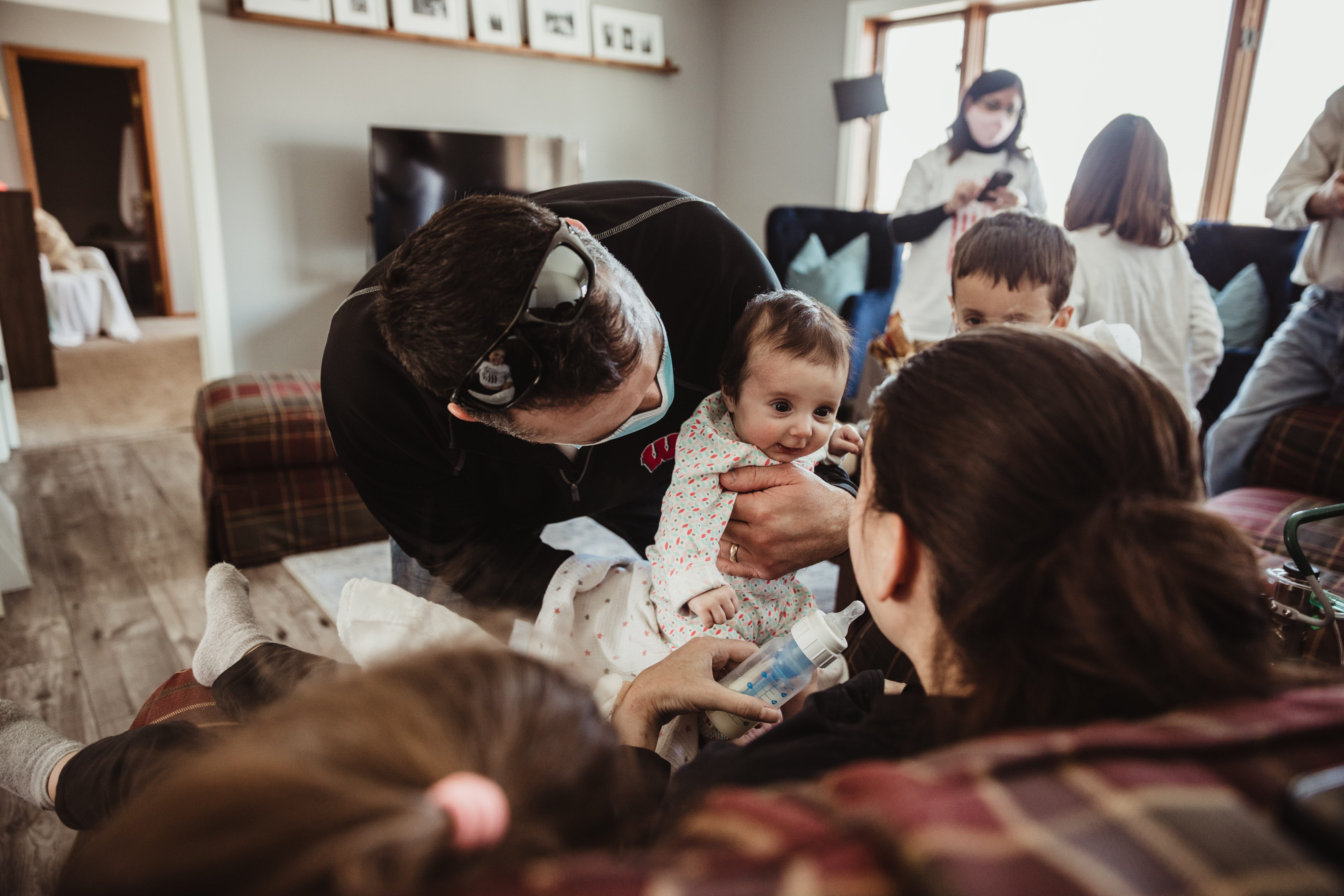
Then Derek brought over Lucy. The baby was nigh three months one-time. Kelsey had never held her.
"Nosotros both locked eyes," she said. The infant's eyes are hazel; Kelsey's brownish.
"I love you," Kelsey said. And and so she thought virtually all of the time she had missed with her baby.
"Momma's sorry."
Twice during Kelsey's long coma, priests visited her infirmary bed to bless her, ane of the seven sacraments in the Cosmic Church building.
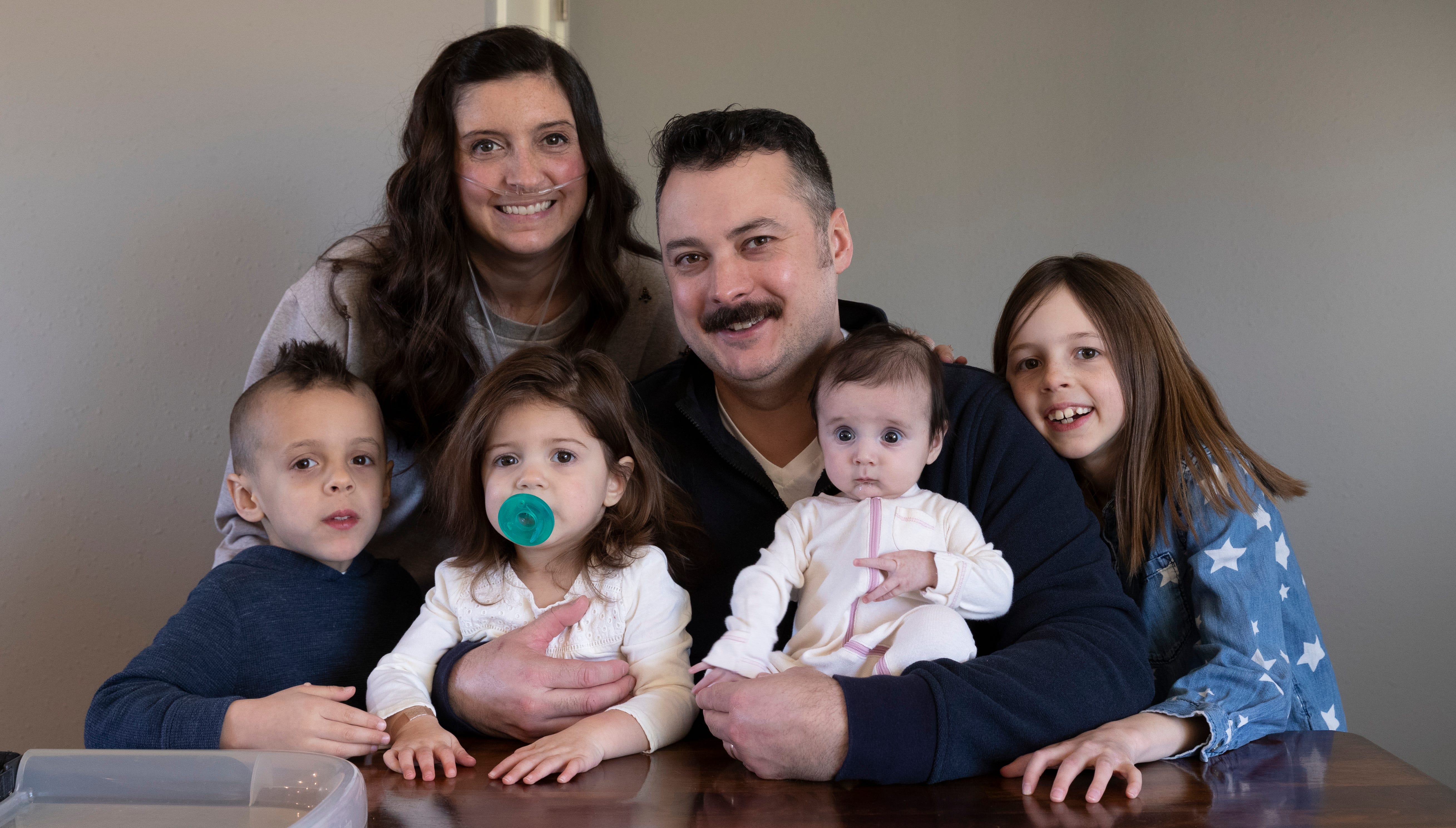
In daily prayers, the Townsends now inquire, not for things they seek, only for "strength in the process."
They pray, also, for all of the doctors and nurses, and the COVID-xix patients struggling in intensive care.
As Kelsey reads bedtime stories to the children, they sometimes ask about the scars on her neck. She tells them near the trouble she had animate and the machines that had to do information technology for her.
She and Derek are determined to be transparent with them about her illness.
Recently, the doctor told Kelsey that her lungs are now up to 50% of their chapters, she says, "which is awesome because when I was at the hospital they were at zero."
McCarthy, her UW Health doc, describes Kelsey's prognosis as "guarded." Medicine has only been dealing with the new coronavirus for a little more than a twelvemonth; doctors have not seen what happens to survivors five years, x years or xx years out.
"We are optimistic for a complete or near-complete recovery," McCarthy said, "but there is simply not enough data still for us to accurately predict long-term prognosis after a patient suffers severe COVID pneumonia."
Kelsey enjoys the small things: folding laundry, cleaning the countertops, loading the children'due south backpacks in the morning.
Recovery is work, and she nonetheless has a ways to get. She labors through hour-long sessions of physical and occupational therapy, twice a calendar week for each.
Simply she can sit and stand without assistance, and no longer uses a walker to go around.
She sees the recovery process transporting her back to some of the same developmental markers that her babe, Lucy Kyu, is now approaching.
They are learning together.
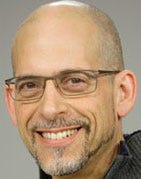
Mark Johnson has written in-depth stories virtually health, science and research for the Journal Lookout man since 2000. He is a three-time Pulitzer Prize finalist and, in add-on, was part of a team that won the 2011 Pulitzer Prize in Explanatory Reporting for a series of reports on the groundbreaking apply of genetic engineering to relieve a 4-year-onetime male child.
Electronic mail him at marking.johnson@jrn.com; follow him on Twitter: @majohnso.
To written report this story, the Milwaukee Journal Sentinel conducted extensive interviews with Derek and Kelsey Townsend and with Kelsey Townsend's doctors at St. Mary's Hospital and at University Hospital, both in Madison.
The Townsends allowed the Journal Sentinel admission to the family's online CaringBridge journal, a detailed business relationship of Kelsey's 84 days in the hospital, Those days included the birth of the couple's fourth kid, Lucy Kyu, and Kelsey's struggle to survive COVID-xix.
In addition, Derek and Kelsey Townsend provided copies of text messages sent during her days in the hospital. Many scenes in the story were reconstructed and verified based on the memories of the participants and on the texts and journal entries.
The newspaper too read multiple scientific papers on COVID-19 and pregnancy, spoke to doctors who have studied the subject field and examined published reports of other pregnant women who suffered severe cases of COVID-19.
Who Has the Baby of the Coma Girl
Source: https://www.jsonline.com/in-depth/news/2021/03/18/wisconsin-mom-nearly-died-covid-19-but-had-miraculous-recovery/4673392001/
0 Response to "Who Has the Baby of the Coma Girl"
Post a Comment